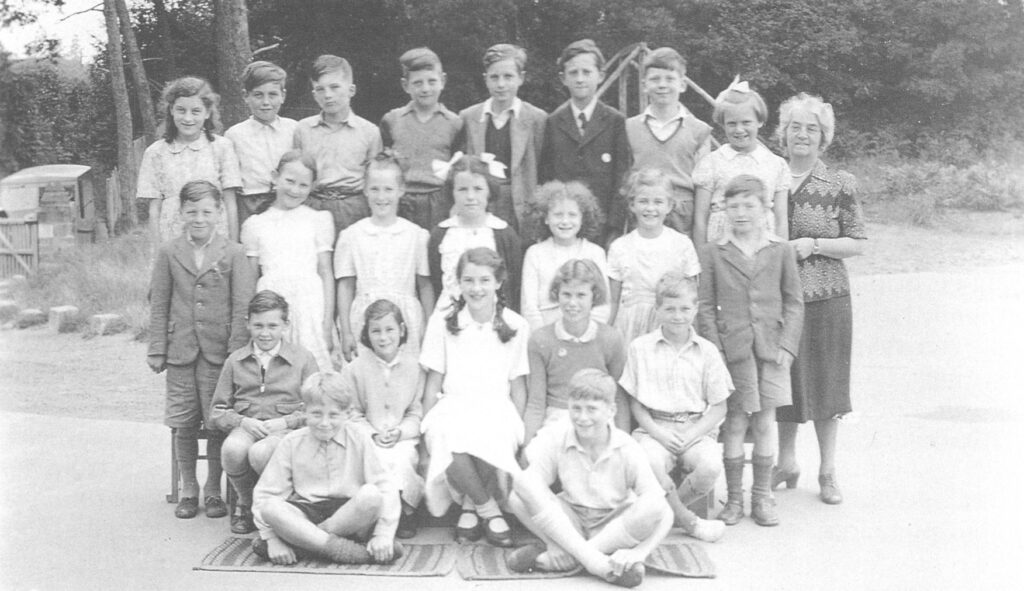
Tag: Betty Turner

  • Maresfield Bonners School

    Maresfield Bonners School

    The Rev’d Richard Bonner, Rector of Maresfield, was buried in the church chancel in 1692. The slab marking his resting-place was found during church repairs in 1837. He was a substantial benefactor for the parish. He left money for educational purposes and also for a Bible, to the value of 8/-, to be given annually to a deserving poor child (under age 14). This charity money was later added to the school funds. He bequeathed a cottage that became the site of a school bearing his name.

    Rents from a property which he owned Norlington Farm, Ringmer, to the value of £2-10-0 yearly were to be used “to teach two poor children in the parish the English tongue and to instruct them in the principles of the Christian religion.”

    At the beginning of the 19th century, the Revd R. Bingham, then curate in charge, started a school for the better class at the Rectory.

    The earlier part of the present school was built in 1819 under the instructions of Lady Frances Shelley to replace a former one which had been the second one built on Richard Bonner’s site.

    Lady Shelley personally supervised the building and accompanied by her eldest daughter Cecilia, walked to the school regularly. In 1873 the Revd Mr Butler organised another rebuilding programme which included the School House and coincided with free education.

    The school buildings were virtually unchanged until after the Second World War when in 1945 Mrs D.A. Hardman became headmistress on the retirement of Mr A.E. Cosham who had been at school for half a century. The Sussex Express Herald in 1945 reported:

    Children at Bonners School, Maresfield bade farewell to their headmaster Mr A.E. Cosham, retiring after over 50 years in the teaching profession.
     
    The occasion was marked by the singing of songs and *Auld Lang Syne*, and he was presented with a cheque by the girls of the first division. Letters of appreciation and good wishes came from parents. Mr Cosham is to be succeeded by Mrs Hardman.
     
    When a pupil at Ringmer Council School, Mr Cosham was stated to be one of the three best-read scholars in the country. At Ringmer School he gained a Queen’s Scholarship and became a student master and was promoted to the headship of Maresfield in January 1907. While he was at Maresfield the school gained many scholarships and a reputation for games, especially cricket. The boys have twice figured in the final of the East Sussex Schools Cricket League and the girls have headed their division in the Stoolball League and have played in the final at Lewes.
     
    Mr Cosham is a member of the Parish Council, organist at the Parish Church, captain of the local cricket and football clubs and superintendent of the recreation ground. He has played football for Ringmer, Maresfield and Uckfield, but it is as a cricketer that he is best known. He has played for Lord Sheffield’s XI, Eastbourne, Hastings, Lewes Priory, Heathfield Park, Mayfield and the Sussex Club and Ground.
     
    In 1905 Mr Cosham married Miss G. Richardson at Ringmer when they were both teachers at Ringmer School. His wife became an assistant teacher at Maresfield in 1909 and retired in 1939. The school has invariably received good reports from both H.M. and the Diocesan Inspectors. A movement is on foot for the village to make a public presentation to Mr and Mrs Cosham and Mr H.W. Tilbury has agreed to act as hon treasurer. Until they can find a suitable house at Maresfield, Mr and Mrs Cosham will reside at Uckfield.

    Mr and Mrs Cosham lived at ‘Oakfield’, New Town, Uckfield for the rest of their lives. Their property adjoined ‘Mountfield Lodge’ which was a preparatory school in the early part of the 20th Century and was in 1988 made into one unit and subsequently divided into eight one bedroomed units and renamed ‘Mountfield House’.

  • Miller Family

    Picture circa 1935 shows the wedding breakfast to celebrate the marriage of Emily Holmes and Albert Miller.

    Albert Miller was one of the sons of Joseph Miller the local builder. J. Miller & Sons still traded in the village in the 1990s, the business carried on by Bill and Robin, grandsons of the founder.

    Mr Miller snr bought Chapel Field, Five Ash Down about 1931 and applied to Uckfield Rural District Council to build forty cottages in the field but was refused planning permission. Three of his four sons were however allowed to build a house each on the field.

    Albert and William Joseph Miller (snr) spent their spare time building themselves 1/2 Diamond Cottages which were completed about 1934. Charlie Miller built himself a house in the field after the Second World War.


    Extract from “Maresfield”, by Betty Turner , © 1991 Betty E Turner

  • Maresfield Village Hall

    Maresfield Village Hall

    The site of the Village Hall (originally called the Maresfield Reading Room) was once a slaughter house.

    It is not known when the Maresfield Reading Room was first built as records are only available from 10th January, 1924 when a meeting was called to decide what should be done with the money (£209-6-8d) raised by the Village Féte in 1919 (see picture) which had originally been intended to extend the Reading Room.

    Present were The Revd A.C.D. Ryder (chairman), C. Wickham Snr, C. Wickham Jnr, L. Skipworth, J. Knight, C. Brown, E. Hazelden, E. Brown, B. Ford, G. Thomas, A. Cosham, A. Brown, J. Steel, F. Butcher, G. Chatfield, E. Ford, G. Goff, C. Rintoul and Miss Philippa Ryder.

    Documents were read explaining that the recreation ground was parish property under the control of the Parish Council but the Reading Room was only lent for the use of the parish and was still the property of Maresfield Park Estate. As the future of the Estate was not settled following its confiscation from Prince Münster in 1914, it was decided to postpone any decision for the time being. Mr C. Brown proposed that the Fund should be invested in the Lewes Building Society at 4% interest, subject to the condition that it might be withdrawn at any time as required.

    At a further meeting on 10th October, 1924, the Revd Mr Ryder said he had interviewed Mr Thomas Place of Northallerton, Yorkshire who had by then acquired the property, with a view to purchase. Mr Place valued the Room at £200 but was willing to sell it to the Parishioners of Maresfield for £100 and he would himself contribute £75 leaving the village just £25 to pay. The Revd Mr Ryder on behalf of Maresfield accepted this generous offer and on 9th February, 1926 the Maresfield Reading Room was legally purchased by the Trustees on behalf of the village. The area bought contained eight perches or thereabouts. The Trustees were the Revd A.C.D. Ryder, Mr C.A. Wickham (Grocer) and Leslie Skipworth (Butcher).

    In 1926 the Village Hall as it was by then called was extended after a second gift of a 30ft frontage of land from Thomas Place. £120 was borrowed from Lewes Building Society and the Parochial Council gave £50. Fifty chairs were purchased for 6/- each and Mr Durrant decorated the old part of the hall for £42-15-0.

    On completion the Hall was insured for £1000.

    In 1928 a strip of land 20 inches wide and 30ft long at the rear was purchased from Doctor E.F. Maynard who then lived next door at ‘Newnham Cottage’. Later a toilet block was added.

    The Village Hall has always had a very representative committee. In 1954 the committee consisted of six elected members and trustees, one member from the Church Council and one each from the Bowls, Cricket, Football, Tennis and Stoolball Clubs and the Women’s Institute.

    The Charity Commission document dated 21st January 1966 gives the use of the property as follows:

    “Held on trust for the purposes of a Village Hall for the use of the inhabitants of Maresfield and the neighbourhood thereof without distinction of sex, political, religious or other opinions.”

    During the Second World War the Village Hall became the centre of social life for thousands of English and Canadian soldiers stationed at the camp who attended the numerous dances. The bookings register shows the period 1941 to 1944 was the most heavily booked period in the hall’s history.

    Mr C. Wickham Snr followed by Mr C. Wickham Jnr served as Trustees for half a century and Mr Bernard Russell of Mockbeggars Farm has been Secretary/Treasurer for about 13 years since Mr C.A. Wickham’s resignation.

    Extract from “Maresfield”, by Betty Turner , © 1991 Betty E Turner

  • Parish Pound & Maresfield Stocks

    MOST PARISHES had their Pounds by which the problem of straying animals was solved. Some old pounds can still be seen, Isfield and Wilmington are good examples.

    Maresfield’s Pound stood beneath a large tree opposite Sandrock which is now part of the recreation ground. It was later removed to just below the Mill Pond where it fell into disuse and then disappeared.

    An old village yarn stated that a villager, Jarrat Smith, had his donkey put in the Pound. The Poundman or ‘Street Runner’ as he was commonly called, asked Mr Smith for the customary 4d for the donkey’s release. Jarrat Smith pleaded he only had  3½d change but the Poundman insisted on full payment so Mr Smith gave him 1/- and received change. The donkey owner then suggested the Poundman should stand him a drink at The Chequers Inn. After the drinks had been served the shilling tendered was found to be a dud one. Mr Smith drank up and departed, leaving the Landlord and the Poundman to argue over the fated coin!

    Maresfield Stocks

    ABOUT 200 years ago stocks and whipping posts were in most parishes. Maresfield Stocks stood on a rough piece of ground between Sandrock and Maresfield Garage where the cemetery now is.

    The Revd Mr Ward-Petley, in his book, recalls that about 1830 a young lad was sent to Uckfield to call for a watch that had been repaired and was given the money to pay for it. However, he spent the money and did not complete the errand.

    He was brought to justice at the stocks. An excited crowd gathered and the children were let out of Maresfield Bonners School just down the road to witness the ceremony. Apparently the boy’s legs were tied with a cord to the bottom of the stocks but before his hands were secured he drew a knife from his pocket and cut the cord to the embarrassment of the parish policeman and to the delight of the crowd. The whipping was said not to be severe although there was plenty of screaming before the pupils returned to their studies!

    The whip was composed of ten lashes of stout whipcord on a short handle.

    Extract from “Maresfield”, by Betty Turner , © 1991 Betty E Turner

  • Commemoration Lamps

    Commemoration Lamps

    THE PARISH STOCKS and Pound have been lost for a century but a much more recent loss has been two ornamental wrought iron lamps that have vanished without trace.

    The first one was erected at the entrance to the recreation ground in 1897 and the remaining inscription on a concrete pedestal says the ground was given by Hervey Percell to celebrate Queen Victoria’s Diamond Jubilee.

    The second one was on the south end of the cemetery wall, again a plaque remains telling us the light was placed there in 1902 to commemorate the Coronation of King Edward VII and Queen Alexandra.


    The Evening Argus reported on 11th January, 1990 that Parklands post box had disappeared without trace overnight. The red box was set in 2 ft of concrete and all that remained was the hole in the ground. The value of the box was given at £100.

    The village public telephone box used to be sited outside the old village post office but was moved to Parklands Estate when it was built after the Second World War. It was thought there was more need for it on the new site and also that as the traffic had so greatly increased it was too noisy in its present position.

    One wrought iron lamp remains on the church wall near the war memorial.

    Extract from “Maresfield”, by Betty Turner , © 1991 Betty E Turner

  • The Chequers

    The Chequers

    THE SOLID red brick-faced Georgian Inn stands in the centre of the village opposite Maresfield Church.

    Land Tax records show that widow Lucy Relph was at The Chequer from 1752 to 1766, so one can assume the building is at least 250 years old.

    County records list the occupier of Chequers and posting house in 1855 as Ray Richard and in 1867, Thomas Goldsmith as occupier of Chequers, commercial inn and farmer.

    In 1990, The Chequers had its status as an Inn restored when eleven period bedrooms and two suites were added. Exposed beams and an inglenook fireplace with a very old iron fireback are features in the bar where a collection of old local pictures adorns the walls.

    During the recent building works, a deep sandstone-faced well was discovered by workmen quite unexpectedly as it had been cemented and tiled over for probably the last 100 years. The well is now an attractive feature incorporated in the new dining room.

    A restaurant to seat 80 has been built in the barn and stables at the rear of the Inn was opened on the 8th November, 1990.


    John Lane’s Masonic Records, 1717-1894 shows The Chequers (Main Street) as the first meeting place of the Lodge of Harmony and Friendship, No. 701, warranted 20th April, 1818. In 1820 the Lodge moved to Freemasons’ Hall (Main Street), thence, in 1823, to Uckfield and finally, in 1827, to Lewes. The Lodge was erased in 1852 being then No. 452 on the list, following the renumbering in 1832.

    Extract from “Maresfield”, by Betty Turner , © 1991 Betty E Turner

  • The Old Rectory

    The Old Rectory

    It is not known how long the Old Rectory was the site of the Rector of Maresfield’s residence but we know that in 1812 the Revd George Woodward who was Rector of Maresfield for 25 years and Vicar of Fletching for over 50 years (at that time clergymen were allowed to hold more than one living at the same time) rebuilt the Rectory. The Revd Mr Woodward is known to have had at least five children whose deaths are recorded on the Rector’s body slab on the south side of the church, so probably the new building replaced a smaller house.

    About 1872 the Revd John Banks Meek Butler built the large and impressive Rectory shown in the photograph.

    The Revd Mr Ryder brought up his family there and entertained many fellow botanists during nearly half a century’s ministry. When he retired, the Revd F.H. Sheldon took the living in 1941 but due to the war and restrictions he was unable to occupy the whole house fully. When he resigned at the end of the Second World War, it was almost impossible to attract an incumbent as the upkeep of the Rectory would by then have taken most of the stipend! The Church Commissioners allowed a smaller house, ‘Pine Grove’, in Maresfield Park to be purchased from Miss Hurst and the Revd and Mrs S.B. Latham took up residence.

    Before the Old Rectory could be sold, a fire (believed to have been started by a tramp) mysteriously broke out on Maundy Thursday, 14th April, 1949, and destroyed a considerable part of the lovely building. The damage may well have been worse had the alarm not been raised by the late Miss Phyllis Fairchild at the Post Office. The remaining part was sold, repaired and divided into several units.

    This was the second time a rectory had caught fire as in 1811 parish records were destroyed when the Rector, the Revd Robert Rivett, had gone to live in Hampshire and left a curate, the Revd Robert Bingham, in charge at Maresfield. The Revd Mr Bingham stood trial at Horsham for wilfully setting fire to his residence to defraud two insurance companies but was found not guilty.

    Another fire took place just after the Second World War when ‘Berigem’, the home of Admiral and Mrs Rundle in Maresfield Park, was completely destroyed partly due to the water supply and pressure being very poor in the parish at the time.

    Extract from “Maresfield”, by Betty Turner , © 1991 Betty E Turner

  • Mabel Weston & Mary Sheldon

    Miss Mabel Kenward, later Mrs Weston, lived at South View, Budletts, which is now Budletts Restaurant. Her father and brother were the local undertakers.

    Mrs Weston and her two cousins, the Misses Maude and Grace Kenward, sang in the Church choir for over 50 years.

    The left hand picture shows Mabel (fourth from left) at the Village Victory Féte and Party, circa 1919. The money raised on this occasion (£209.6.8d) later purchased the Maresfield Reading Room, later to be known as the Village Hall.

    Mrs Mary Sheldon formed the first Mothers’ Union Group in the parish and was first enrolling member. Mrs. Daisy Brown (seated third left) donated the M.U. banner which was made at the Anglican Convent in East Grinstead.


    Standing far right is Captain John Martin, (retired) Church Army Officer who gave great assistance to several Rectors both in the pulpit and the parish. He was apprenticed blacksmith at Maresfield Forge before being called to the ministry. He married Miss Florence Brown of Tanyard Farm (seated third right); they lived with Mrs Daisy Brown at The Fernery when they retired and returned to the village, later to move in their twilight years to a Church Army home at Fleet, Hants.

    Extract from “Maresfield”, by Betty Turner , © 1991 Betty E Turner

  • Rev A.C.D Ryder

    Algernon Charles Dudley Ryder (1848-1943) was Rector of Maresfield from 1902 to 1941.

  • The Bells of Saint Bartholemew’s

    There is a peal of eight bells in the fine embattled tower which was added to the church in the early 15th century by John de Pelham, one of the powerful family of Sussex landowners. There were originally six bells that were recast in 1787. An old parish account book records the taking down and rehanging of the bells cost £23-10-0, an expense that was defrayed by a special church rate.

    Two bells were added in 1950 during the ministry of the Revd S.B Latham given by Mr and Mrs F.J. Bellingham of ‘Southern Cottage’, Maresfield Park in memory of their daughter Marjorie, who died of tuberculosis in 1941 and Mrs Rundle (formerly Mrs Robinson) of ‘Berigem’, Maresfield Park in memory of her son. The bells were dedicated at a Thanksgiving Service for Victory to which the Revd F.H. Sheldon (Rector for most of the war) was invited.

    The poster for the Village War Memorial dedication of the bells, 1950, designed by Mrs M.E. Rundle
    PitchInscriptionDateWeight1
    TREBLE17876 cwt
    SECONDPROSPERITY TO THIS PARISH17876¾ cwt
    THIRDFEAR GOD HONOUR THE KING17878 cwt
    FOURTHTHIS PEAL WAS CAST AT GLOVSTER BY CHAS X17879 cwt
    FIFTHIAS SAXBY12X WILLIAM OSBOVRNE178711 cwt
    TENORJOHN NEWNHAM3178715 cwt
    SEVENIN MEMORY OF RBR 194219505 cwt
    EIGHTIN LOVING MEMORY OF MARJORIE 1917-1941 FJB & AMB19505½ cwt
    1. “CWT” is an abbreviation for “Hundredweight”, a unit of weight equal to 112 pounds (50.8 kg) ↩︎
    2. James Saxby lived at ‘Marshalls’ ↩︎
    3. John Newnam lived at ‘The Cross’ ↩︎

    The six original bells, after a period of non-use in the Second World War (church bells were only to be rung in the event of a German invasion as a warning signal), were recast and rehung as the Village War Memorial.

    The first bells were cast by the Rudhall Foundry of Gloucester.

    The later bells were cast and hung by Mears and Stainbank of Whitechapel Foundry, London.

    Extract from “Maresfield”, by Betty Turner , © 1991 Betty E Turner